Article Sidebar
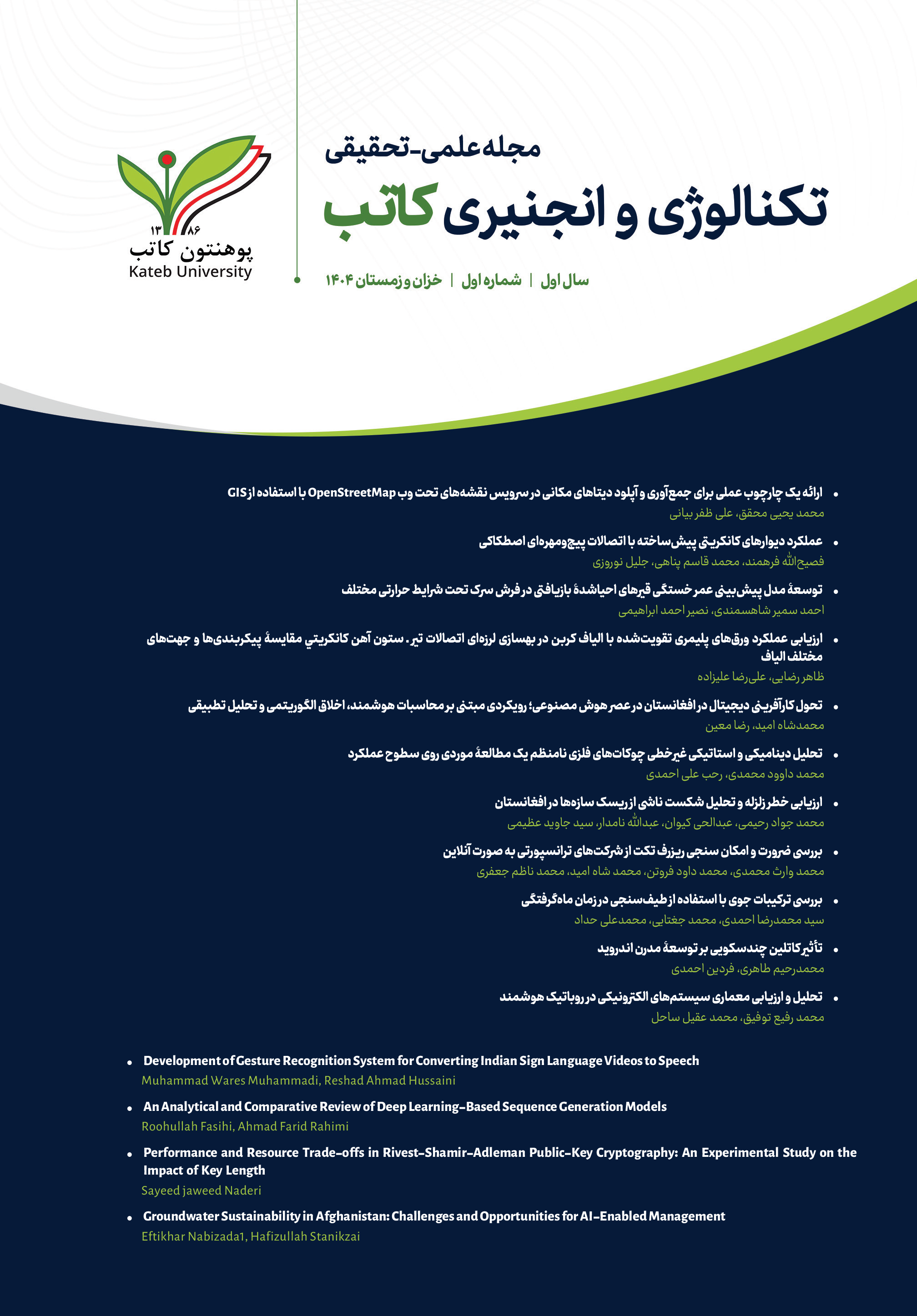
Performance of precast concrete walls with friction bolted connectors
Main Article Content
Abstract
To evaluate the performance of prefabricated concrete walls with friction bolted connectors, static (cyclic) and dynamic (time history) analyses were conducted on four one‑story models, four two‑story models with simple arrangement, and four two‑story models with zigzag arrangement. One‑story models have one, two, three, and four panels, respectively. Two‑story models with simple arrangement have one, two, three, and four panels per story, respectively. Two‑story models with zigzag arrangement have two, four, six, and eight panels per story, respectively. The total effective width of panels is the same in all one‑story models and also in all two‑story models. To enhance energy dissipation and ductility, these panels are connected to each other by friction bolted connectors, and self‑centering is achieved by post‑tensioning elements (two elements embedded in each panel), with the total cross‑sectional area of post‑tensioning elements being the same in all models. Seismic performance, hysteresis curves, lateral stiffness, energy dissipation, lateral displacement, permanent lateral displacement, and damage were evaluated and compared. The results show that as panel width decreases (or the number of panels increases), lateral displacement and energy increase, while lateral stiffness, permanent lateral displacement, and damage decrease. In other words, increasing the number of panels (and thus the number of friction bolted connectors) increases the ductility of the models.
Keywords
Article Details
How to Cite
Similar Articles
- Mohammad Jawad Rahimi, Abdul Hai Keyvan, Abdullah Namdar, Sayed Javid Azimi, Seismic Hazard Assessment and Failure Analysis of Structural Risk in Afghanistan , Kateb Scientific-Research Journal of Technology and Engineering: Vol. 1 No. 1 (1404): Vol. 1, No 1, Autumn & Winter 2025-2026
- Zaher Rezaie, Ahmad Omid Roshan, Performance Evaluation of Carbon Fiber-Reinforced Polymer (CFRP) Sheets in the Seismic Retrofit of Reinforced Concrete Beam–Column Joints: A Comparison of Different Fiber Configurations and Orientations , Kateb Scientific-Research Journal of Technology and Engineering: Vol. 1 No. 1 (1404): Vol. 1, No 1, Autumn & Winter 2025-2026
- Mohammad Dawood Mohammadi, Rajab Ali Ahmadi, Nonlinear Static and Dynamic Analysis of Irregular Steel Frames: A Case Study on Performance Levels , Kateb Scientific-Research Journal of Technology and Engineering: Vol. 1 No. 1 (1404): Vol. 1, No 1, Autumn & Winter 2025-2026
- Mohammad Rafi Toufiq, Mohammad Aqil Sahel, Analysis and Evaluation of Electronic System Architectures in Intelligent Robotics , Kateb Scientific-Research Journal of Technology and Engineering: Vol. 1 No. 1 (1404): Vol. 1, No 1, Autumn & Winter 2025-2026
- Sayeed jaweed Naderi, Performance and Resource Trade-offs in Rivest–Shamir–Adleman Public-Key Cryptography: An Experimental Study on the Impact of Key Length , Kateb Scientific-Research Journal of Technology and Engineering: Vol. 1 No. 1 (1404): Vol. 1, No 1, Autumn & Winter 2025-2026
- Muhammad Wares Muhammadi, Reshad Ahmad Hussaini, Development of Gesture Recognition System for Converting Indian Sign Language Videos to Speech , Kateb Scientific-Research Journal of Technology and Engineering: Vol. 1 No. 1 (1404): Vol. 1, No 1, Autumn & Winter 2025-2026
- Ahmad Samir Shahsamandy, Nasir Ahmad Ibrahimi, Development of a Fatigue Life Prediction Model for Rejuvenated Recycled Asphalt Binders under Various Thermal Conditions , Kateb Scientific-Research Journal of Technology and Engineering: Vol. 1 No. 1 (1404): Vol. 1, No 1, Autumn & Winter 2025-2026
- Mohammad Yahya Mohaqeq, Ali Zafar Bayani, A Practical Framework for Collecting and Uploading Spatial Data to the OpenStreetMap Web Mapping Service Using GIS , Kateb Scientific-Research Journal of Technology and Engineering: Vol. 1 No. 1 (1404): Vol. 1, No 1, Autumn & Winter 2025-2026
You may also start an advanced similarity search for this article.